
Ask anyone who has spent January in a west-facing Canberra living room, and they will tell you the same thing. By four in the afternoon, the sun has done its work. The blinds are down, the reverse-cycle is flat out, and the room still feels like it is holding its breath.
Most of that heat did not creep in through the walls. It came through the glass. That is the simple reason awnings reduce energy bills. They stop the sun before it reaches the window, so your air conditioner has far less to fight.
In this article, we walk through what the published figures actually say, how different awning styles suit different windows, and where motorisation and weather sensors fit in.
Why Summer Heat in Canberra Starts at the Glass
Windows are the weak link in most homes. The Australian Government’s Your Home guide says unprotected glass is often the greatest source of heat entering a house, and that up to 87 per cent of a home’s heat can be gained through glazing (Australian Government, n.d.-b, n.d.-c).
The sun does the rest. The ACT Government’s Suburban Land Agency (2024) describes direct sunlight as generating as much heat as a single-bar radiator over every square metre it hits. It also says effective shading can block up to 90 per cent of that heat.
Now picture a big sliding door on the western side of a house. A few square metres of glass, a few radiators aimed at your lounge room, all afternoon. That is the summer heat Canberra homeowners are up against, and it is hard to fix from the inside.
What the Savings Figures Actually Say
You will see plenty of percentages thrown around for awnings. Some have no source attached at all. We would rather point you to government figures and explain what they mean.
The NSW Government (2025) lists external shading, which includes awnings, shutters and solar screens, as an upgrade that can save about 40 per cent per year on heating and cooling bills by cutting the time your air conditioner runs. Treat that as a best-case ballpark, not a promise. It comes from NSW rather than the ACT. Canberra is a neighbouring inland climate with hot summers, so it is a fair benchmark, but it is not a guarantee for your house.
The same page gives a rough cost range: from about $200 for a custom DIY solar screen to $5,000 or more for a large motorised retractable awning (NSW Government, 2025).
So what decides where your home lands? Which way the glass faces. How big it is. Whether it is single or double glazed. How well the ceiling is insulated. And, honestly, whether the awning is actually out when the sun is hitting the window. That last one matters more than people expect.
Shade Solutions and Passive Cooling
Passive cooling is just a tidy way of saying you deal with heat through design rather than power. Your Home describes it as using design choices to reduce heat gain and increase heat loss, and it lists shading windows as one of the main methods (Australian Government, n.d.-a).
Awnings are one of the simplest shade solutions because they work outside the glass. That is the whole trick. Once sunlight passes through a window, it heats the floor, the furniture, and the air. Inside blinds and curtains help with glare and privacy, but by then the heat is already in the room.
Sustainability Victoria (n.d.) makes the same point. External shading is much more effective at keeping a home cool than internal blinds or curtains, because it stops the heat reaching the glass. It also notes that using both external and internal coverings gives the best protection. So nobody is telling you to bin your curtains.
Folding Arm Awnings and Other Options
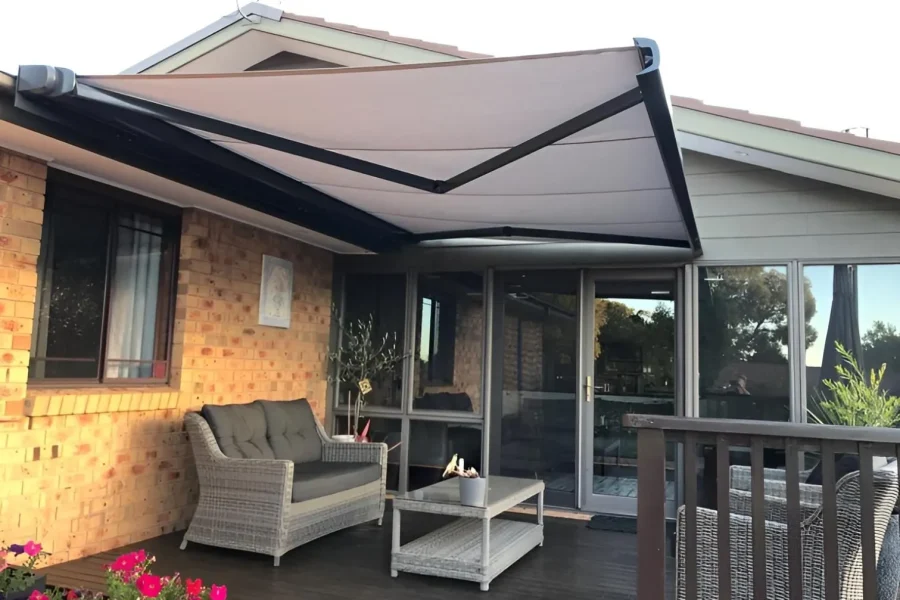
Folding arm awnings give wide, post-free shade over patios and decks. They extend when you want cover and fold away when you do not, which also lets the winter sun back in. They are a popular choice for Canberra outdoor entertaining areas, and they come in manual or motorised versions.
Straight drop awnings, sometimes called outdoor blinds, drop vertically over a window or balcony. They are particularly useful on west-facing windows during those long summer afternoons, and they roll up neatly when you are done.
Pivot arm awnings suit windows where you want shade but still need airflow and natural light, such as bedrooms and living areas. Zip screen awnings run in a track on each side, which keeps the fabric steady in wind. Automatic awnings are manually operated but have a built-in safety feature that retracts them in high winds.
Which Way Does the Window Face?
The best shading depends on where the sun sits. Your Home suggests fixed or adjustable horizontal shading above north-facing windows, and adjustable vertical shading for east and west, where the sun is low and comes in at an angle (Australian Government, n.d.-c). Sustainability Victoria (n.d.) adds that eaves and pergolas do little for low morning and afternoon sun, and that adjustable vertical devices such as awnings suit north-east and north-west windows.
South-facing windows get almost no direct summer sun, so they rarely need shading in summer. That can save you money on the quote.
Motorised Awnings and Weather Sensors
This is where a good awning gets a lot smarter. Any awning is only as useful as the hours it is actually out, and most of us are not home at two in the afternoon to wind it down.
Our motorised awnings run on motors and hubs from Somfy, Acmeda and Alpha, and we can add optional sun and wind sensors so the awning runs itself. On a folding arm awning in an exposed spot, a wind sensor will retract it automatically once the wind reaches a set speed. That protects the awning, and it protects your investment.
We motorise blinds and curtains too, using the same hubs, and motorisation can be added to existing homes as well as new builds. Control can come from a phone, a remote or voice commands. Some settings respond to temperature and lighting conditions, which is exactly what you want from a shade that is meant to earn its keep in summer.
One honest note. Sensors will not create savings on their own. They just make sure the awning is in the right position at the right time, without you having to think about it. If you are curious about how that would work with your windows, ask us at your measure and quote.
Conclusion
An awning is not magic. But when the sun is the problem, stopping it outside the glass is one of the most sensible moves you can make, and the published figures back that up. Just keep your expectations honest: your results will depend on your windows, your home and how the awning is used.
If you would like to know what would suit your place, we offer a free on-site measure and quote across Canberra and Queanbeyan. We look at sun angle, wall type and wind exposure before we recommend anything. Call us on (02) 5119 2542 or visit https://www.elitewindowfurnishings.com.au/ to get started.
References
- ACT Government, Suburban Land Agency. (2024, June 29). Saving energy with home shading systems. https://suburbanland.act.gov.au/news/news-item/2024/06/29/saving-energy-with-home-shading-systems
- Australian Government. (n.d.-a). Passive cooling. Your Home. https://www.yourhome.gov.au/passive-design/passive-cooling
- Australian Government. (n.d.-b). Passive design. Your Home. https://www.yourhome.gov.au/passive-design
- Australian Government. (n.d.-c). Shading. Your Home. https://www.yourhome.gov.au/passive-design/shading
- NSW Government. (2025, December 15). External shading of windows and doors. NSW Climate and Energy Action. https://www.energy.nsw.gov.au/households/upgrades/external-shading
- Sustainability Victoria. (n.d.). Reducing heat gain through home windows. https://www.sustainability.vic.gov.au/energy-efficiency-and-reducing-emissions/building-or-renovating/windows-and-shading/reducing-heat-gain-through-windows